
Is High Peak Antenna Gain (>5 dBi) Always Better?
Why antenna radiation patterns matter more than peak gain alone
Is High Peak Antenna Gain (>5 dBi) Always Better?

One common observation is that many customers, particularly those without an RF engineering background, request small antennas with a peak gain of 5 dBi or higher, sometimes expecting this level of gain across the entire operating frequency range.
But is this always a practical requirement?
The answer is not necessarily.
Antenna performance involves several important trade-offs. Let me explain four key considerations in simple terms.
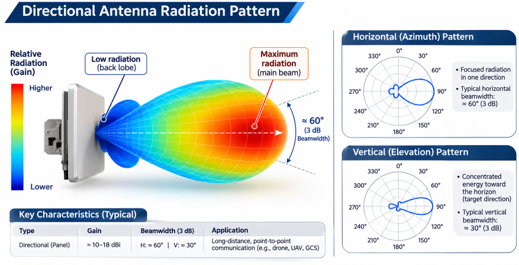
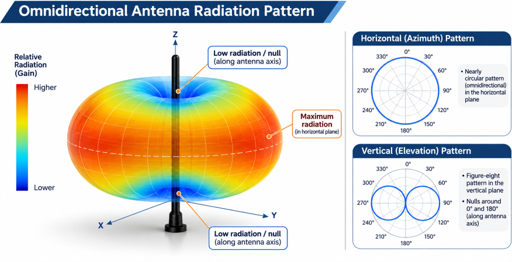
Antenna gain, expressed in dBi, describes how strongly an antenna radiates or receives signals in a particular direction compared with a theoretical isotropic radiator.
An isotropic radiator distributes energy equally in all directions. It is an ideal reference that cannot be physically realized.
A higher-gain antenna generally concentrates more radiated energy in certain directions, resulting in less radiation in others.
This can be beneficial when the direction of communication is known.
For example, a directional antenna used for point-to-point communication can be aligned toward the receiving station to improve signal strength and communication range.
Similarly, a GNSS patch antenna is typically designed to provide good reception toward the sky, where the navigation satellites are located.
However, when the direction of communication is unpredictable, an omnidirectional antenna may be more suitable.
An omnidirectional antenna provides relatively uniform coverage around the antenna in the horizontal plane, although its radiation varies with elevation.
The key message: Select an antenna based on its radiation pattern and intended application, not simply its maximum peak gain.
1. Higher Peak Gain Does Not Necessarily Mean Better Coverage
2. Higher-Gain Omnidirectional Antennas Have Their Limitations
How can an omnidirectional antenna achieve higher peak gain?
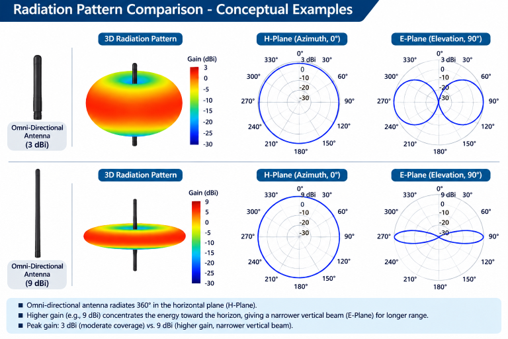
One common approach is to concentrate more radiated energy toward the horizontal plane by narrowing the vertical beamwidth.
Imagine a doughnut-shaped radiation pattern.
As the antenna’s directivity increases, the doughnut becomes flatter, concentrating more energy toward the horizon while reducing coverage at higher and lower elevation angles.
This can be advantageous for fixed wireless installations where communicating devices are located at approximately the same elevation.
However, consider a drone application.
A drone continuously changes its orientation as it banks, tilts, climbs, or descends.
If its antenna has a very narrow vertical radiation pattern, these movements can cause the communication link to fall into a region of reduced antenna gain, potentially weakening the signal or even causing a temporary loss of communication.
A lower-gain antenna with broader elevation coverage may therefore provide more consistent connectivity, depending on the drone’s flight conditions and the relative position of the ground station.
The key message: Higher peak gain can improve performance in certain directions, but wider angular coverage may be more important for moving devices.
3. Achieving High Gain Across a Wide Frequency Range Is Challenging
Modern wireless applications often require antennas to operate across multiple frequency bands.
For example, cellular antennas may need to support frequencies ranging from approximately 600 MHz to several GHz, depending on the markets, technologies, and frequency bands involved.
Designing a compact antenna that maintains high gain across such a wide frequency range presents several engineering challenges.
Antenna designers must balance several parameters:
- Impedance matching, commonly evaluated using VSWR or return loss.
- Radiation efficiency, which determines how effectively accepted RF power is radiated.
- Radiation pattern and peak gain.
- Physical dimensions and installation constraints.
- Performance consistency across the required frequency bands.
An antenna can achieve good VSWR without necessarily providing high radiation efficiency or high peak gain.
Likewise, peak gain may vary significantly across different operating frequencies.
There is no universal rule that an antenna performs best at the center frequency. Its performance depends on the antenna structure, design optimization, and surrounding environment.
The key message: For wideband antennas, consistent efficiency, suitable radiation patterns, and adequate gain across the required bands are often more meaningful than a single high peak-gain figure.
4. Antenna Size and Operating Frequency Matter
Antenna dimensions are closely related to the wavelength of the operating frequency.
Lower frequencies have longer wavelengths and generally require larger antenna structures to achieve good radiation efficiency.
For example:
- At 700 MHz, the free-space wavelength is approximately 43 cm.
- At 2.4 GHz, the wavelength is approximately 12.5 cm.
- At 5 GHz, the wavelength is approximately 6 cm.
This explains why designing a compact, efficient antenna for lower-frequency cellular bands can be particularly challenging.
When an antenna is electrically small compared with its operating wavelength, achieving good impedance matching, radiation efficiency, and bandwidth simultaneously becomes more difficult.
At higher frequencies, the shorter wavelength allows a given physical antenna size to accommodate a larger electrical aperture, potentially enabling higher directivity.
However, higher-frequency antennas also face challenges such as manufacturing tolerances, material losses, and sensitivity to installation conditions.
The key message: Antenna gain requirements must be evaluated together with operating frequency, physical dimensions, and installation conditions.
Conclusion: The Best Antenna Is Not Necessarily the One With the Highest Gain
When selecting an antenna, we should ask more than just:
“What is the peak gain?”
We should also consider:
- Where is the communicating device located?
- Is the application fixed or mobile?
- What radiation pattern is required?
- What are the operating frequency bands?
- How much space is available for the antenna?
- What are the antenna’s radiation efficiency and VSWR?
- How will the antenna be installed in the final product?
A peak gain of 3 dBi with suitable coverage may deliver better real-world connectivity than an antenna rated at 8 dBi if the latter concentrates its radiation in the wrong directions.
Ultimately, antenna selection is about optimizing wireless performance for the application, not maximizing one specification.
I would be interested to hear from fellow RF engineers and wireless product designers:
Have you encountered situations where a lower-gain antenna performed better than a higher-gain alternative?
Need Help Selecting an Antenna?
Share your application, operating frequency bands and installation constraints with the iConnexion team so we can discuss your antenna requirements.
Explore iConnexion’s antenna range as you shortlist options for your wireless design.
