
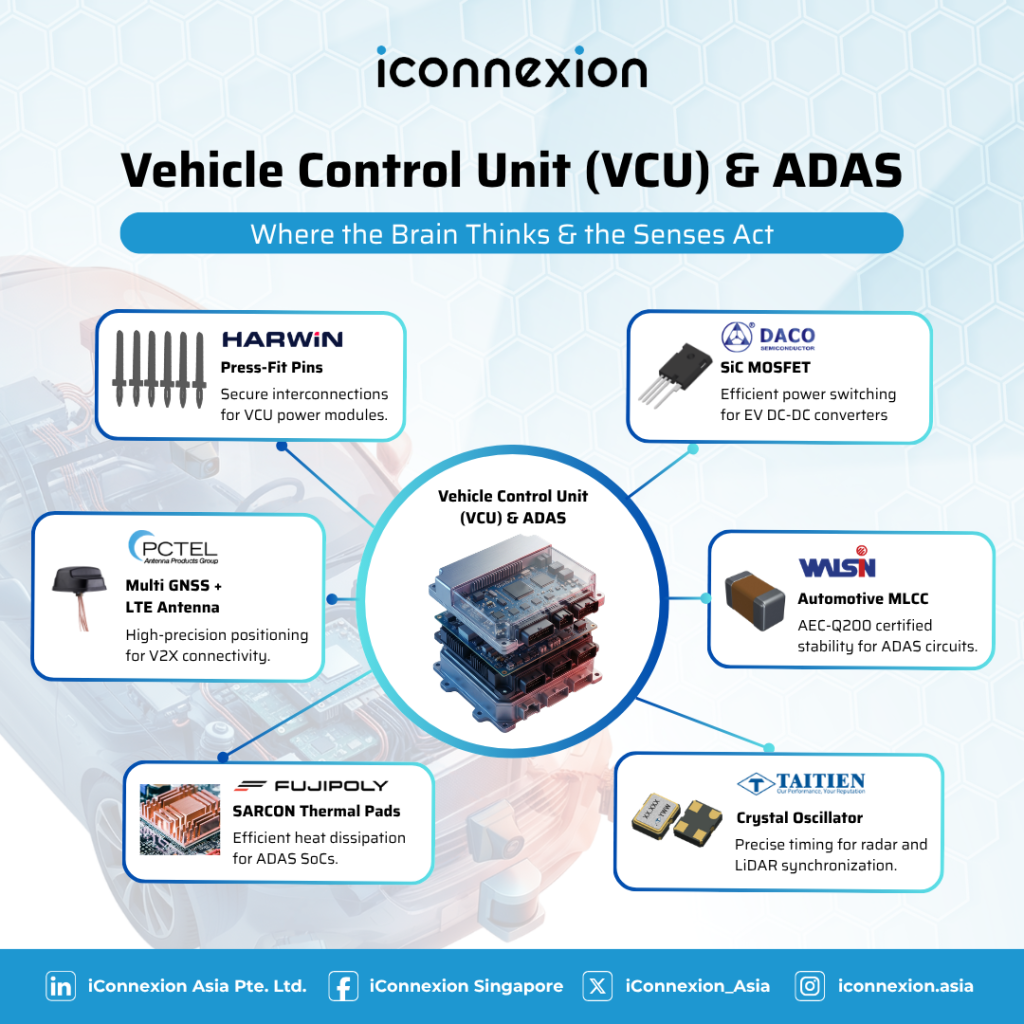
Electric vehicles (EVs) are becoming increasingly intelligent, relying not only on efficient power conversion but also on advanced control and sensing capabilities. Two critical subsystems driving this intelligence are the Vehicle Control Unit (VCU) and Advanced Driver Assistance Systems (ADAS).
The VCU acts as the central brain of the EV — coordinating power distribution, managing communication between subsystems, and ensuring the vehicle responds safely and accurately to driver inputs in real time. ADAS, on the other hand, enhances vehicle safety and automation through technologies such as radar, LiDAR, cameras, and high-precision positioning — enabling features like lane keeping, automatic emergency braking, and adaptive cruise control.
To ensure reliable operation, these systems require high-performance electronic components capable of handling high-frequency switching, precision timing, stable power delivery, and robust mechanical connections in demanding automotive environments.
VCU and ADAS systems are widely used across various electric and intelligent mobility platforms, including:
These applications demand components that deliver precision, durability, and electrical stability under harsh operating conditions — from extreme temperatures to mechanical vibration and high-frequency electromagnetic environments.
In a modern EV architecture, the VCU manages multiple critical functions simultaneously — including DC-DC power conversion, CAN bus communication, battery management coordination, and motor torque control. Alongside it, ADAS relies on a network of sensors, processors, and communication modules that must operate with precise timing and stable power at all times.
This process requires multiple supporting components, including:
Each component plays a crucial role in maintaining system efficiency, safety, and long-term reliability across the entire VCU and ADAS architecture.
Designing VCU and ADAS systems for electric vehicles presents several engineering challenges:
Engineers must carefully select components that meet these demanding performance, reliability, and automotive qualification requirements.
iConnexion supports EV VCU and ADAS system development with a trusted ecosystem of components from six leading brands:
1. DACO Semiconductor – SiC MOSFET
2. Harwin Solution – Press-Fit Pins
3. PCTEL – Multi GNSS + LTE Antenna
4. Walsin – Automotive MLCC (Multilayer Ceramic Capacitors)
5. Fujipoly – SARCON Thermal Pads
6. Taitien – Crystal Oscillator
Ready to evaluate components for your VCU or ADAS design? Our team is here to help — whether you need a sample to test or engineering advice to get started.
Complete the short form below
Need more information?
Contact Us
As electric vehicles evolve toward greater intelligence and autonomy, the demand for high-performance, reliable components across VCU and ADAS systems continues to grow.
By combining proven technologies from DACO Semiconductor, Harwin, PCTEL, Walsin, Fujipoly, and Taitien, iConnexion helps engineers design safe, efficient, and high-performance EV control and sensing systems — from power switching to precision timing, connectivity, and thermal management — supporting the next generation of electric and autonomous mobility.
