
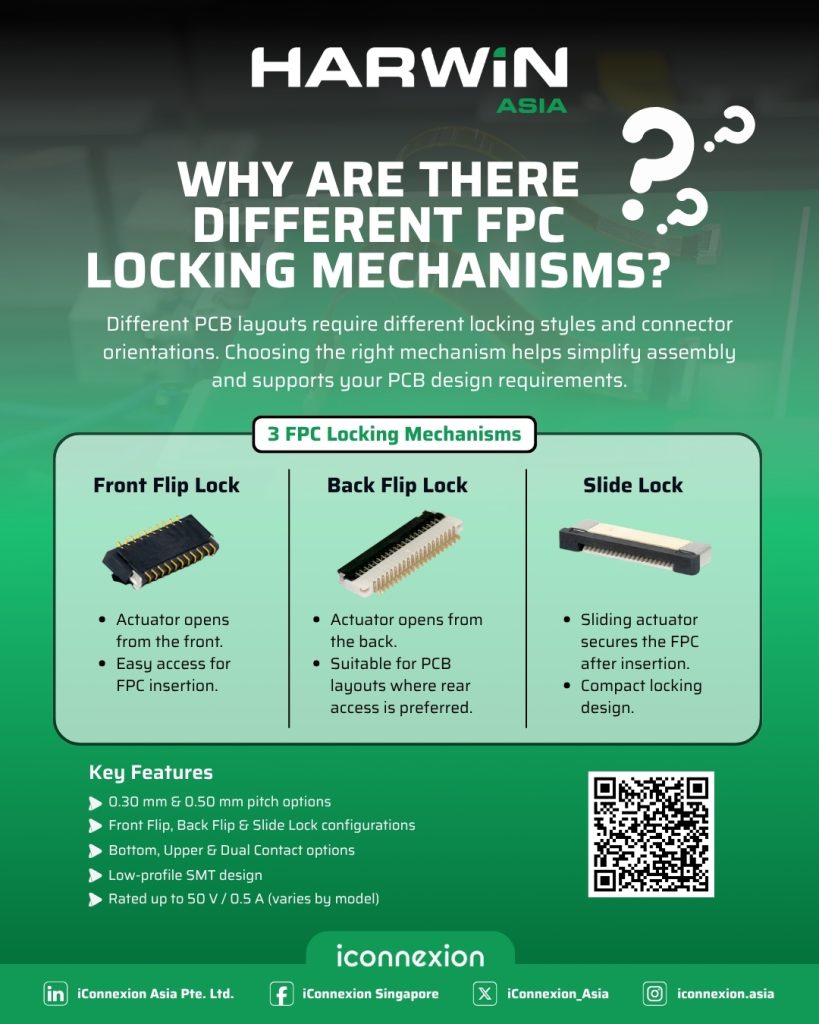
Flexible Printed Circuit connectors provide a compact method of connecting flexible circuits to printed circuit boards where available space, connector orientation, and cable routing must be carefully considered.
Selecting an FPC connector is not only about choosing the correct pitch. The locking mechanism, contact orientation, connector height, cable thickness, and insertion direction can all influence how easily the connector fits into the PCB layout and assembly process.
The Harwin Solutions FPC Connector Range includes multiple locking mechanisms, contact configurations, and fine-pitch options, allowing engineers to compare connector styles according to their specific mechanical and PCB design requirements.
✔ Available in 0.30 mm and 0.50 mm pitch options
✔ Front Flip Lock, Back Flip Lock, and Slide Lock actuator types
✔ Bottom Contact, Upper Contact, and Dual Contact configurations
✔ Low-profile SMT designs for compact PCB assemblies
✔ Multiple connector heights and compatible cable thickness options
✔ Rated up to 50 V and 0.5 A, depending on model
✔ Individual technical drawings available for each part number
Harwin Solutions FPC Connectors are suitable for electronic designs that require compact board-to-flex connections, including:
✔ Display and interface modules
✔ Embedded electronic devices
✔ Control boards
✔ Portable electronic equipment
✔ Compact PCB assemblies
✔ Electronic modules using flexible printed circuits
The suitability of each connector depends on the selected part number, cable orientation, PCB layout, and overall system requirements.
Different PCB layouts do not always provide the same level of access around the connector. In some designs, the flexible cable may need to be inserted from the front, while other layouts may require access from the opposite side or a sliding actuator due to surrounding components and limited mechanical space.
Understanding these differences helps engineers evaluate which locking mechanism, contact position, and connector orientation best fits the intended PCB design.
The Harwin Solutions FPC Connector Range provides multiple connector configurations for compact PCB and flexible circuit designs.
With Front Flip Lock, Back Flip Lock, and Slide Lock options, together with Bottom, Upper, and Dual Contact configurations, engineers can compare different connector styles according to their required cable direction, assembly access, and board layout.
The range also includes 0.30 mm and 0.50 mm pitch options, multiple product heights, and different cable thickness requirements. Individual technical drawings are available for each part number to support connector evaluation and mechanical design review.
Access key product information, including available part numbers, pitch options, product heights, actuator types, rated current, contact configurations, cable thickness requirements, and individual technical drawings to help you identify a suitable FPC connector for your PCB design.
👉 Fill in the form below to access the Harwin Solutions FPC Technical Drawing.
Need more information?
Contact Us | Request Sample
Choosing the appropriate FPC connector involves more than selecting the correct pitch. Locking mechanism, actuator direction, contact orientation, connector height, and cable thickness can all affect PCB layout and assembly.
By offering multiple locking styles and contact configurations, the Harwin Solutions FPC Connector Range provides engineers with greater flexibility when designing compact board-to-flex connections.
