
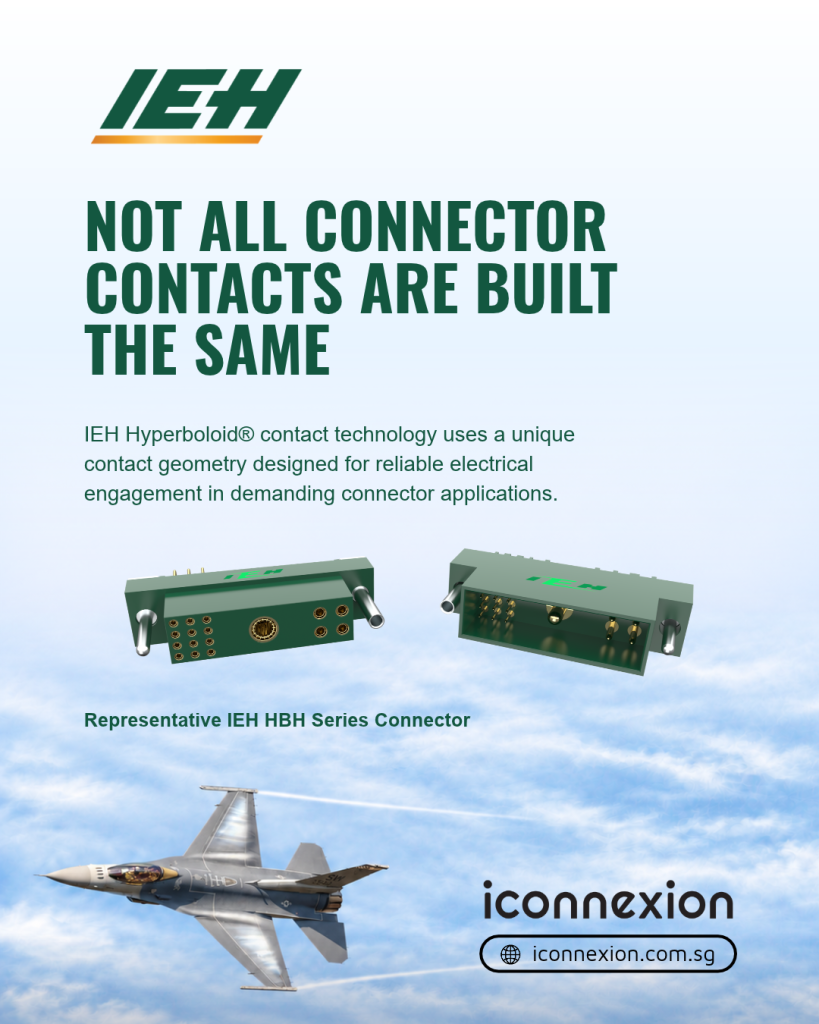
A connector can be fully mated and still experience intermittent electrical contact under vibration. In avionics and industrial equipment, small movements at the pin-to-socket interface can interrupt a signal or power connection. The shape of the contact and how it engages the pin both influence how the connection responds to movement.
An IEH Hyperboloid® socket uses angled wires arranged in an hourglass shape. When the pin is inserted, the wires flex around it, forming multiple lines of electrical contact. As the pin moves under vibration, the wires can flex with it, helping maintain contact. The multiple contact paths also contribute to low contact resistance, which can help limit temperature rise at the contact under load.
The IEH HBH Series applies this technology in a modular connector that accepts power and signal contacts in a single housing. Designers can review different module combinations, mounting styles and terminations to suit their electrical and mechanical requirements.
IEH Hyperboloid® contact technology is relevant to systems where vibration or repeated mating makes electrical continuity a design consideration. The HBH Series is one option to evaluate when the same connector needs to carry both power and signals.
For a specific design, check the selected configuration against the expected vibration profile, current load, allowable temperature rise and mating-cycle requirements.
Review electrical and mechanical specifications, power and signal module options, plug and receptacle drawings, mounting and termination styles, and ordering information.
Download the IEH HBH Series Catalogue
IEH Hyperboloid® contact geometry uses flexible socket wires and multiple contact paths to help maintain electrical continuity under vibration. The HBH Series brings that geometry into a configurable power and signal connector, giving designers a starting point for evaluating contact layout, mounting and termination options.
Evaluating an IEH connector for your application? Share your requirements with iConnexion so we can help you review suitable options.
